
News / Interview | Luís Taborda Barata
Coordinator of Thematic Line 3 – Hormones, Infection, Inflammation, and Metabolism at the RISE-Health Research Unit and Full Professor at the Faculty of Health Sciences, University of Beira Interior (UBI).
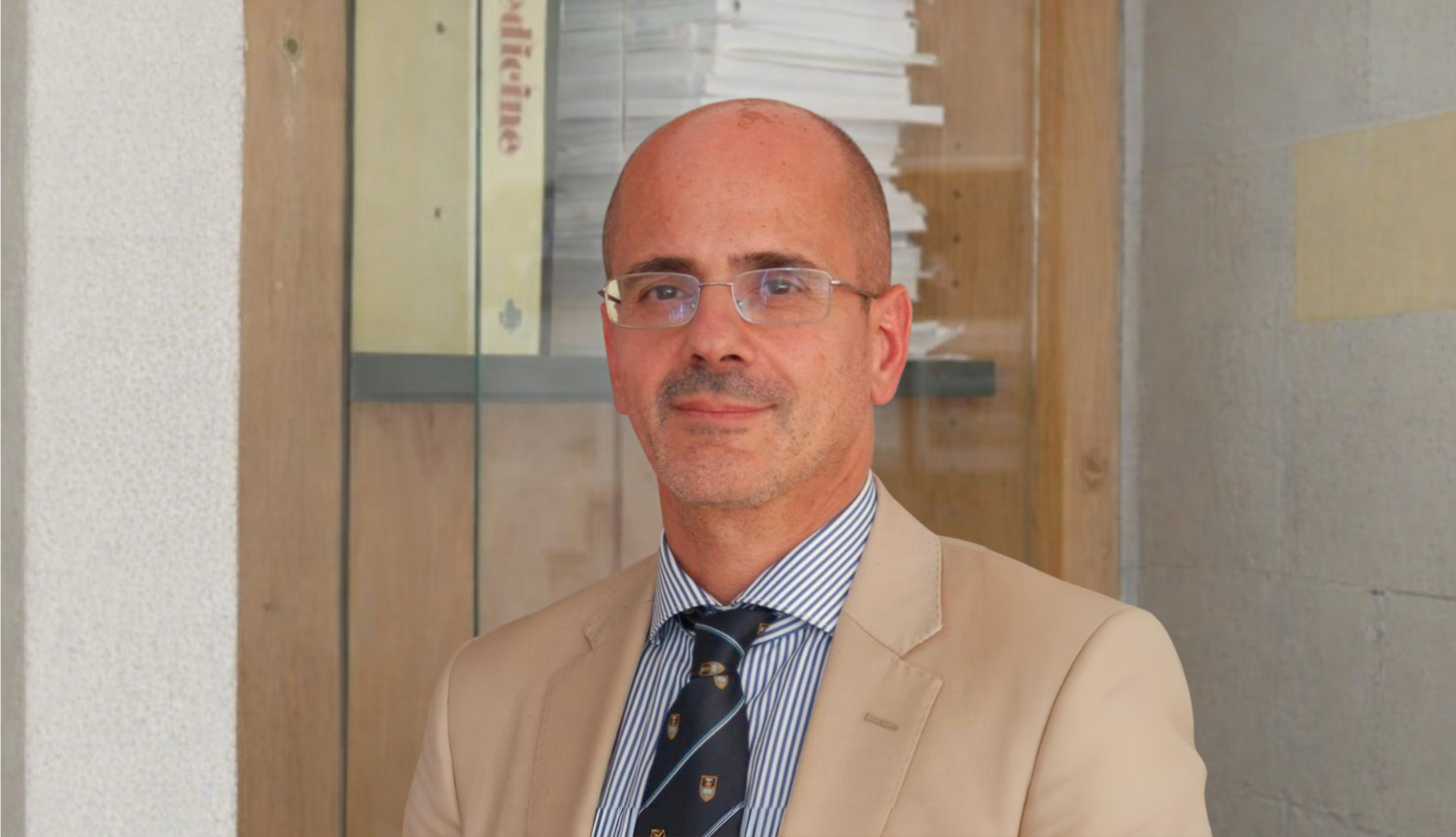
Luís Taborda Barata is a full professor of Medicine at the Faculty of Health Sciences of the University of Beira Interior (UBI), where he teaches and conducts research in the Department of Medical Sciences. He was also the scientific coordinator of the Center for Health Sciences Research (CICS-UBI) and coordinator of Thematic Line 3 – Hormones, Infection, Inflammation, and Metabolism at the RISE-Health Research Unit.
A specialist in immunoallergology, he is director of the Department of Allergy and Clinical Immunology at the Cova da Beira Local Health Unit and conducts clinical work in the field of allergic and respiratory diseases. Throughout his career, he has held various scientific and institutional positions, including coordinating the Center for Health Sciences Research, chairing the Scientific Council of the Foundation for Science and Technology, and serving as vice-chair of the Advisory Board of the Agency for Clinical Research and Biomedical Innovation.
He earned his medical degree from the University of Coimbra in 1987 and completed his clinical training in Immunoallergology at the University of Coimbra Hospitals and the Royal Brompton Hospital in London. In 1993, he completed a master’s degree in Immunology from the University of Porto, and in 1998, a Ph.D. in Medicine from Imperial College London, with research focused on the mechanisms of allergic diseases.
Throughout his academic and scientific career, he participated in the creation and development of the Faculty of Health Sciences at the University of Beira Interior, where he served as chair of the Department of Medical Sciences, director of the medical program, and dean of the faculty. His scientific work focuses primarily on the field of immunoallergology and respiratory diseases, with participation in national and international research projects and collaborations.
What led you to choose medicine and, more specifically, the specialty of immunoallergology?
It’s hard to say what led me to choose medicine, because I think it has always been part of my soul and my very being, as if it were an obvious necessity, yet at the same time inexplicable. Coming from a family with a tradition in law (dating back to the 17th century) and with only two ancestors who were doctors, I couldn’t attribute it to genetics.
That indescribable need meant that, when I had to list my preferred university majors, I simply wrote “Medicine—Faculty of Medicine, University of Coimbra.” I think this choice was a mix of wanting to help others, wanting to challenge the limits of what is possible in treating diseases, and wanting an adventurous element, since I had plans to become a “Royal Flying Doctor” in Australia. I ended up fulfilling all of this to some extent, particularly through my work in Angola and South Africa.
As for Immunoallergology, that wasn’t easy either. I always thought about pursuing Pulmonology, although I also really liked the field of Immunology. While I was in medical school, those were my two favorite areas, but I always favored Pulmonology.
However, one day, a colleague from the Abel Salazar Institute of Biomedical Sciences at the University of Porto (ICBAS-UP) alerted me to the opening of 12 spots for a Master’s in Immunology at that institution, which was coordinated by the exceptional Professor Maria de Sousa. I found it very interesting and applied. To my surprise—since there were many applicants—I was accepted, and throughout the first year of the master’s program, I was fascinated by the scientific exposure at the highest level and by world-renowned figures in Immunology. This situation led me, for the first time, to doubt my choice of Pulmonology as my future specialty and to become interested in the possibility of pursuing Immunoallergology, which combined the fascination of Immunology with the prospect of being able to treat allergic conditions that were already becoming increasingly common.
On the day I had to choose my specialty, I was at the Regional Health Administration of the Center (I believe), mentally weighing the two options ad nauseum. The staff member who was relaying the candidates’ decisions to the other two centers (Lisbon and Porto) was pressuring me, since time was running out and she couldn’t wait any longer, until, suddenly, I blurted out “Immunoallergology.”
I entered the specialty at the University Hospitals of Coimbra and have always had a great fondness for that field, but also for Pulmonology—curiously, in England, where I worked for several years on my doctorate and completed several clinical rotations in the specialty of Immunoallergology, I ended up being registered as a Pulmonology resident and learned a great deal from that field as well, because the specialty of Immunoallergology did not yet exist in that country. In short, direct and linear paths are not my forte.
As Coordinator of Thematic Line 3 at RISE-Health, what are the main scientific objectives and priorities you have defined for this research group?
As Coordinator of Thematic Line 3 (LT3) at RISE-Health, I felt that all members of all the groups comprising this line needed to be involved in defining its scientific objectives and priorities. Thus, I laid the groundwork for a five-year Strategic Plan for TL3, with strategic and operational objectives and success indicators, which I opened up for general discussion and suggestions for changes from all members. Thus, in this plan developed by everyone, we have seven strategic objectives, three of which are overarching: 1) To deepen the study of interfaces between hormones, metabolic aspects, and inflammation in various contexts; 2) To develop new methods, strategies, and diagnostic and prognostic tools; 3) To contribute to innovative treatments for diseases.
The remaining overarching strategic objectives concern the consolidation of LT3: 4) To increase the quality of scientific output; 5) To strengthen strategic collaborations; 6) To consolidate human resources; 7) To increase the acquisition of competitive funding.
Finally, in addition to these scientific objectives and priorities, each of the four LT3 groups—Hormones & Metabolism (H&M); Metabonomics, Obesity & Related Disorders (MORD); Medical Microbiology & One Health (MMed&OH); Exposome-Related Inflammatory & Allergic Diseases (ERIAD)—has its own objectives, which are also included in the Strategic Plan.
In your opinion, what is the role of translational research in improving clinical practices and health policies today?
Translational research is fundamental to improving clinical practices because, particularly through various “Omics” approaches, it enables the identification of biomarkers and biopathological processes linked to various factors in a disease’s pathophysiology, contributing to strengthening aspects not only of prevention but also of diagnosis, monitoring, prognosis, and treatment. For example, by establishing links between basic and clinical research, translation also helps streamline and improve various aspects related to the development of new drugs, biologics, and medical devices. In this context, translational research is crucial as a foundation for Personalized and Precision Medicine and also for strengthening the range of parameters that enable the application of Evidence-Based Medicine, with robust indicators—such as those of efficacy and safety—that are as relevant to patients and disease treatment as they are to monitoring and striving to improve the quality of healthcare delivery.
Several of these aspects resulting from translational research and their validation in a clinical context have been translated into clinical guidelines and standards, which are reflected in health policies. The field in which I work, related to asthma, is one of the best examples of the role of translational research in improving clinical practices, with certain biomarkers playing a fundamental role in the characterization and stratification of patients, with new biologic treatments aimed at treating —and possibly promoting remission—of the disease based on these biomarkers, with new approaches to disease monitoring through mobile health (mHealth), and with several of the results from these approaches being used to define new guidelines for managing and/or treating the disease.
The creation of RISE-Health marked the merger of several research units into a single structure. In your opinion, what impact can RISE-Health have on national research? How important is a research unit like RISE-Health for the future of science and health in our country?
RISE-Health could have a major impact not only on national research but also on international research. As the largest R&D unit in the field of clinical and translational research at the national level, it consists of several hubs spread across a large part of the country, bringing together numerous researchers and clinicians in diverse laboratories and clinical settings with high scientific capacity, aligned “from the molecule to the community and from the community back to the molecule.”
This strong translational axis has enormous potential given the wide range of knowledge, techniques, and equipment associated with it, ranging from in vitro studies to clinical trials, including the analysis and management of health data, all within the same UI&D.
Furthermore, this axis is associated with a clear international focus, with active participation in various European and global scientific networks, which we intend to expand even further. In fact, the diversity that characterizes this new UI&D allows us to offer a much richer contribution to these networks. However, to further expand its national and international relevance, RISE-Health needs to continue its efforts to consolidate itself as a strong UI&D, supported by a deeply integrated network of hubs, which allows for the importance of all these hubs to be recognized, maximizing synergies and complementarities that result in an increasing number of integrated and collaborative projects, generating disruptive innovation. On the other hand, RISE-Health is also in a unique position to further develop a new and highly relevant axis: that of teaching-research. In fact, as a whole, it offers rich interaction across a wide range of programs, allowing research to go hand in hand with education across different vertical lines, from undergraduate to graduate programs (non-degree courses, master’s degrees, and doctorates).
By knowing how to expand and strengthen the two aforementioned areas, RISE-Health’s contribution to the future of science and health in our country will be sustainable, highly innovative, and have a significant scientific, clinical, and societal impact, particularly through its translation into health and education policies.